
Performance 2026-05-14
Adaptive Resistance: Why Training Should Respond to You in Real Time
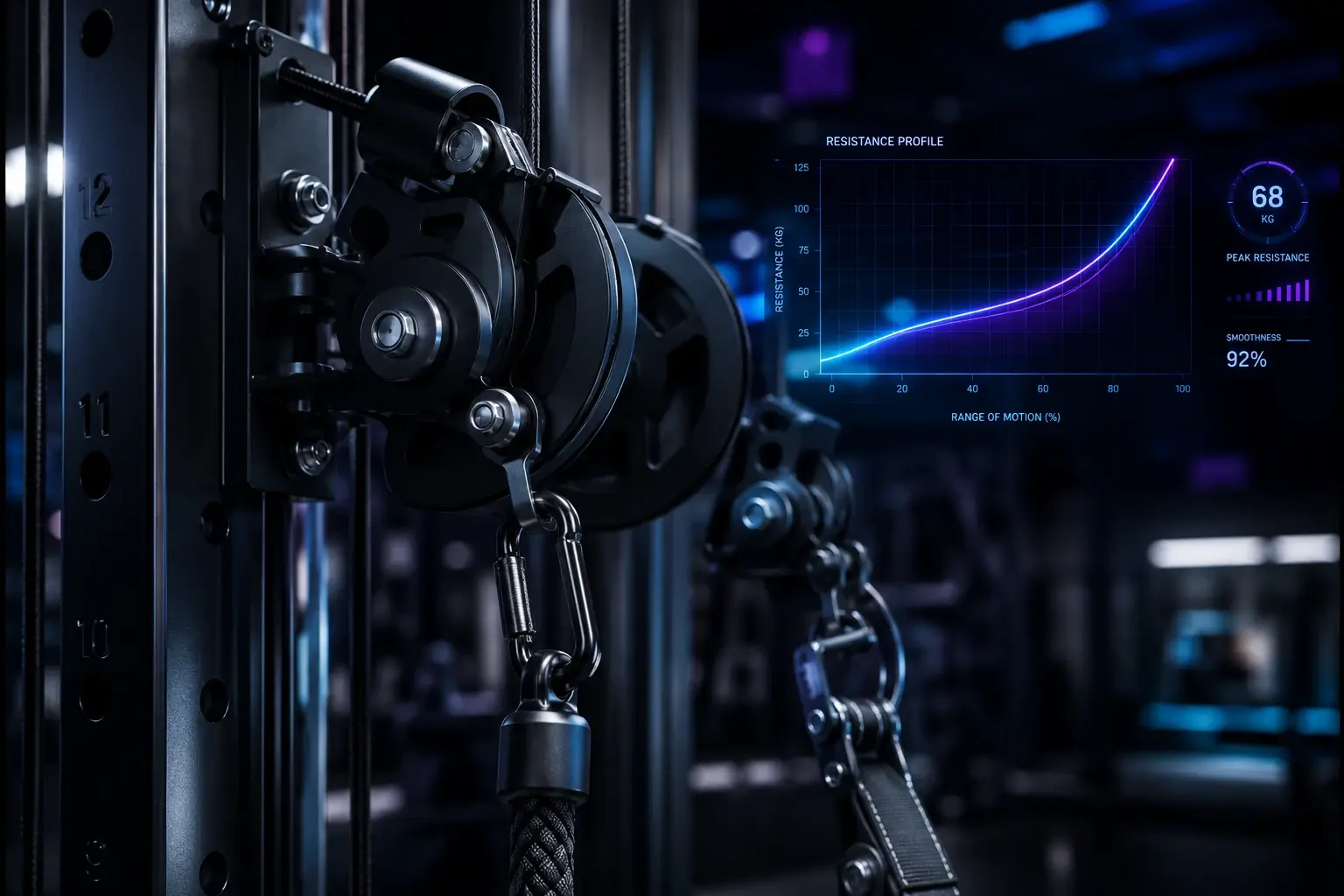
Most resistance is dumb. It doesn’t know how tired you are, how fast you’re moving, or whether you’re struggling through the last rep or breezing through the first. It just sits there — fixed, indifferent — and leaves your body to figure out the rest.
That’s not a knock on traditional training. Fixed resistance has built extraordinary athletes for generations. But it’s worth understanding what it can’t do, because the gap between what static weight offers and what adaptive resistance delivers is larger than most people realize.
What Adaptive Resistance Actually Means
Adaptive resistance refers to any system where the level of resistance changes in response to the user’s effort, speed, or force output in real time. Rather than moving a fixed load from point A to point B, you’re working against something that pushes back relative to how hard you’re pushing — or eases off when your output drops.
This isn’t a new concept. Accommodating resistance through bands and chains has been used in powerlifting for decades. What’s changed is how precisely and responsively modern systems can manage it, and how accessible that capability has become outside of elite training environments.
The Tension Problem with Fixed Resistance
Here’s something most gym-goers experience without having a name for it: during almost any lift, there are portions of the movement where the muscle is loaded effectively, and portions where it isn’t.
Take a standard bicep curl. At the bottom of the movement, the weight is relatively easy to manage. Through the middle range, the load peaks. At the top, as your forearm approaches vertical, mechanical advantage shifts and the effective load drops significantly. The muscle is still working, but the resistance has functionally decreased — not because you changed anything, but because physics did.
This is the tension problem. Fixed resistance can only be truly optimal at one point in a movement’s range. Everywhere else, it’s either too light to be maximally effective or too heavy to move safely. You’re essentially designing a workout around the weakest link in the chain.
Adaptive resistance solves this by adjusting throughout the movement. When your mechanical advantage is high and you could handle more load, it provides more. When it drops, the resistance drops with it. The result is consistent, meaningful tension across the full range of motion — which is where real muscular development happens.
Reducing Wasted Motion
Wasted motion is a related problem. When resistance doesn’t match effort, compensations emerge. Momentum takes over. Form degrades. People swing weights they should be pressing, lean into movements they should be controlling, and use their stronger muscle groups to carry their weaker ones.
None of this is laziness — it’s the body doing exactly what it’s designed to do, finding the most efficient path through a task. But efficiency in that context means bypassing the targeted muscle, not training it.
When resistance adapts to effort, the incentive to cheat the movement disappears. There’s no momentum to exploit because the system accounts for it. Every portion of the rep has to be earned, which means every portion of the rep is contributing to the outcome.
This produces cleaner movement patterns over time — not because the user is being disciplined into better form, but because the training environment makes good form the path of least resistance.
Smoother, More Honest Progression
Progression in traditional training is measured in weight increments — add five pounds, add ten. It’s a blunt instrument. The jump from one weight to the next can be significant enough to compromise form, increase injury risk, or simply be too much for where the athlete is on a given day.
Adaptive resistance allows for finer-grained progression. Rather than jumping between fixed loads, resistance can increase gradually and continuously as the user’s output warrants it. Progression becomes a response to demonstrated capacity rather than a scheduled event.
This also makes training more honest. Fixed weights don’t account for variation in daily readiness — the difference between how you perform on a good day versus a depleted one. Adaptive resistance adjusts to actual output, which means effort is always calibrated to the individual rather than to an arbitrary number on a plate.
Training That Meets You Where You Are
The deeper value of adaptive resistance is philosophical as much as it is mechanical. Training that responds to you in real time reframes the relationship between the athlete and the tool. The equipment stops being a fixed obstacle to be overcome and becomes a dynamic partner in the process.
That matters particularly for athletes at the extremes — beginners who need the resistance to stay manageable while technique develops, and advanced athletes who need stimulus that can keep pace with their capacity. A system that adjusts in real time serves both without requiring different equipment, different programming, or a training philosophy built around managing limitations.
The Bottom Line
Fixed resistance will always have a place in training. But it asks the athlete to adapt to it. Adaptive resistance flips that relationship — the load adjusts to the athlete, maintains tension where it matters, eliminates the inefficiencies that static weight can’t address, and allows progression to track actual performance rather than arbitrary increments.
Training that responds to you isn’t a luxury feature. It’s a more accurate model of how physical development actually works.