
Longevity 2026-05-14
Joint-Friendly Strength Training for Long-Term Progress
There’s a version of strength training that treats discomfort as a feature. Push through the pain, grind through the fatigue, and wear the soreness like a badge. For a certain demographic, in a certain season of their training life, that approach produces results.
But it has a ceiling — and the ceiling tends to arrive in the form of an injury, a chronic ache that won’t resolve, or a quiet decision to stop training altogether because the cost has started to outweigh the benefit.
Long-term progress doesn’t come from training as hard as possible. It comes from training consistently over years, and consistency requires a body that holds up. That’s where joint-friendly strength training stops being a concession and starts being a strategy.
What “Joint-Friendly” Actually Means
Joint-friendly training is sometimes misread as easy training — lighter weights, shorter sessions, lower intensity. That’s not quite right. The goal isn’t to reduce challenge. It’s to reduce unnecessary stress on connective tissue, tendons, and joints while maintaining meaningful muscular stimulus.
The distinction matters because joints and muscles have different recovery profiles. Muscle tissue recovers relatively quickly and adapts robustly to progressive load. Connective tissue — tendons, ligaments, cartilage — recovers slowly and adapts more conservatively. When training consistently ignores that difference, the muscular system can outpace what the joints are prepared to handle. That’s where overuse injuries begin.
Joint-friendly training respects that gap. It builds strength in a way that the whole system — not just the muscles — can sustain over time.
Controlled Movement as a Foundation
One of the most effective and underused tools in joint-friendly training is simply slowing down. Controlled movement — deliberate tempos, full range of motion, minimal reliance on momentum — places load directly on the targeted muscle rather than distributing it across the joint and surrounding tissue.
When a weight is moved with momentum, the joint absorbs force that the muscle didn’t generate. Over time, that accumulates. The lift looks productive, but the stress is landing in the wrong place.
Controlled movement eliminates that transfer. It keeps the demand on the muscle, reduces peak force on the joint, and builds the kind of deep, stable strength that protects the body rather than quietly degrading it. It’s also harder — not in a damaging way, but in the way that produces real adaptation.
The Role of Smooth Resistance
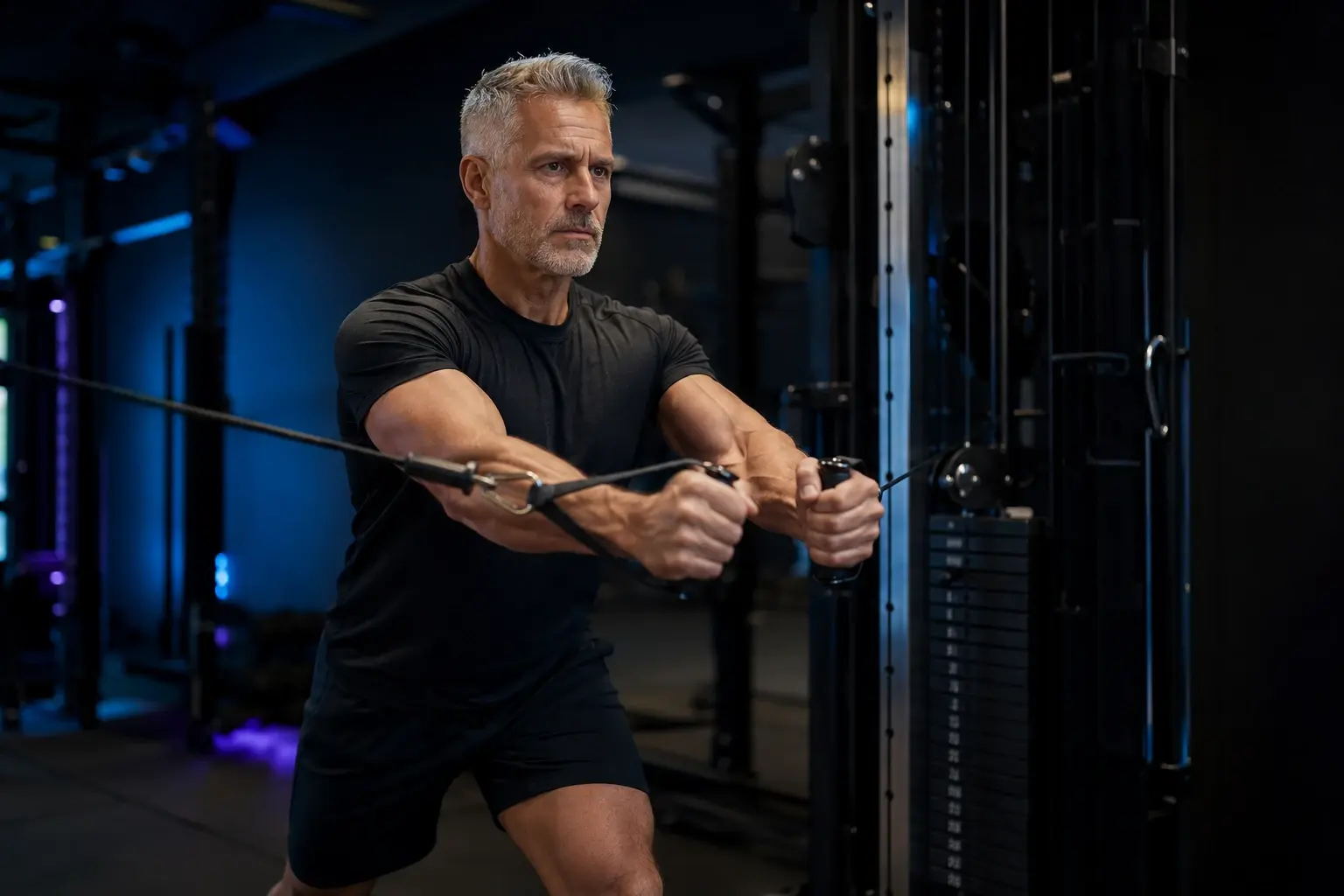
Resistance that is smooth and consistent throughout a movement is significantly easier on joints than resistance with abrupt transitions or momentum-dependent loading.
Consider the difference between a controlled cable movement and a jerky free weight rep where the load shifts unpredictably. Both might involve the same weight, but the joint stress they produce is different. Abrupt loading — the kind that comes from dropping into a movement, bouncing at the bottom of a squat, or releasing tension between reps — creates transient force spikes that connective tissue absorbs unevenly.
Smooth resistance, whether through cables, bands, or well-designed machines, maintains consistent tension and eliminates those spikes. The joint experiences load that builds and releases gradually, which is substantially more sustainable across thousands of repetitions over months and years of training.
Full-Body Mechanics and Why They Matter
Joints don’t operate in isolation. The health of a knee depends partly on the strength and mobility of the hip above it and the ankle below it. Shoulder problems often originate in a weak upper back or restricted thoracic spine. Training that addresses the body as an integrated system — rather than a collection of individual muscles — reduces the compensatory patterns that lead to joint stress.
Full-body mechanics means training movements, not just muscles. Pushing, pulling, hinging, squatting, carrying — these patterns distribute load across multiple joints and muscle groups simultaneously, which reduces the concentration of stress at any single point. An athlete who can move well through full-body patterns is building resilience into the entire kinetic chain, not just improving isolated metrics.
This is why mobility work, stability training, and movement quality aren’t accessories to joint-friendly training — they’re central to it. Strength built on top of poor mechanics doesn’t protect the joint. It reinforces the dysfunction.
Why Low-Impact Strength Work Compounds Over Time
The case for low-impact training is ultimately a case for compounding. Small, consistent gains made without interruption outperform aggressive cycles of hard training and forced recovery. An athlete who trains 48 weeks a year at moderate intensity accumulates more quality work than one who trains 30 weeks a year at high intensity with frequent setbacks.
Injuries don’t just cost the weeks of recovery they require. They cost the detraining that follows, the psychological reset of returning to lower loads, and often a permanent modification of what the joint can handle going forward. The athlete who never gets injured doesn’t just stay healthier — they get better faster, because the compound interest of uninterrupted training has nowhere to go but up.
Low-impact strength work — controlled tempos, smooth resistance, sound mechanics, appropriate loading — keeps that compounding intact. It’s not the slow path. It’s the path that doesn’t get interrupted.
Training for the Athlete You’ll Be in Ten Years
The most useful frame for joint-friendly training isn’t injury prevention, though that’s part of it. It’s longevity. The question isn’t just whether a training approach works right now — it’s whether it builds a body that can keep training effectively at 45, 55, 65, and beyond.
Joints that have been respected accumulate capacity. Tendons that have been loaded progressively and allowed to recover become more resilient, not less. Movement patterns trained with quality become more ingrained and more protective over time. The body rewards the long game in ways it simply cannot reward the short one.
The Bottom Line
Strength training doesn’t have to be brutal to be effective. The athletes who train the longest, progress the most, and maintain the highest quality of movement late in their training lives are rarely the ones who pushed hardest in any given session. They’re the ones who understood that the body is a system to be developed, not a machine to be run until it breaks.
Joint-friendly strength training isn’t about training less. It’s about training in a way that earns you the right to keep training — and keeps getting better the longer you do it.